
Supertake and Catalyst turn a plain-English take into a portfolio. Centaur tested Supertake's top takes: two opposite theses ran 0.91 correlated, and eight books came down to about two bets.

Centaur · Research
October 29, 2026 · 4 min read

Two launches in two weeks mark a new paradigm in agentic investing.
On 28 September 2026, USV unveiled Supertake, the first company incubated inside the firm: you type a take in plain English, such as "humanoid robots are coming to every home", and an agent builds the portfolio, places the trades through your brokerage and rebalances it over time. On 8 October, Catalyst announced a $30m seed round led by Sequoia to build AI agents that turn a trader's thesis into a strategy, from choosing the instruments to executing the trade.
The paradigm is that the take becomes the interface. You say what you believe, and an agent does the rest. That is a real unlock. Their thesis is that, until now, the distance between a view on the world and a position in a brokerage account is where most investors either gave up or got it wrong.
Centaur's thesis is that this distance is not a translation step. It is a great part of the job. Turning a take into a trade, managing that trade, and fitting it into a portfolio is a process, and edge may leak at every step. The details are where the alpha lives.
This is not a new idea. Chris Camillo, who coined "social arbitrage", built one of retail's best-known track records on everyday observations. The observations were the easy part, he has said. His edge was connecting each one to the stock it would actually move, and getting there before Wall Street did.
To test it, Centaur took the top takes on Supertake's leaderboard and asked a simple question: how much of each portfolio is actually the take?
A take only becomes a bet when it is the main driver of the portfolio's P&L. Two public portfolios on Supertake's leaderboard show why that is not as simple as it sounds.
Nikita's Home AI Edge Compute portfolio aims to capture the trend of inference leaving the cloud for devices people own. Anish's Watts and Wafers, on the other hand, positions for a future where cloud AI compute keeps compounding faster than the market prices. If Nikita is right, the data-center demand Anish needs grows slower. If the take is to really matter, the theses should pull against each other.
Yet the books do not differ meaningfully. They share six names, which make up roughly 30% of each book. Historically, their daily returns are 0.91 correlated.

Two opposite takes, effectively one portfolio.
Only a third of the book is in names that win if inference moves to devices. The rest either wins only if inference stays in the cloud, or wins either way. Memory and storage is a fifth of the weight and a third of the risk, and that risk share holds in every window tested. Over the 12 months to 8 October 2026, the current memory sleeve would have delivered 73% of the book's return.
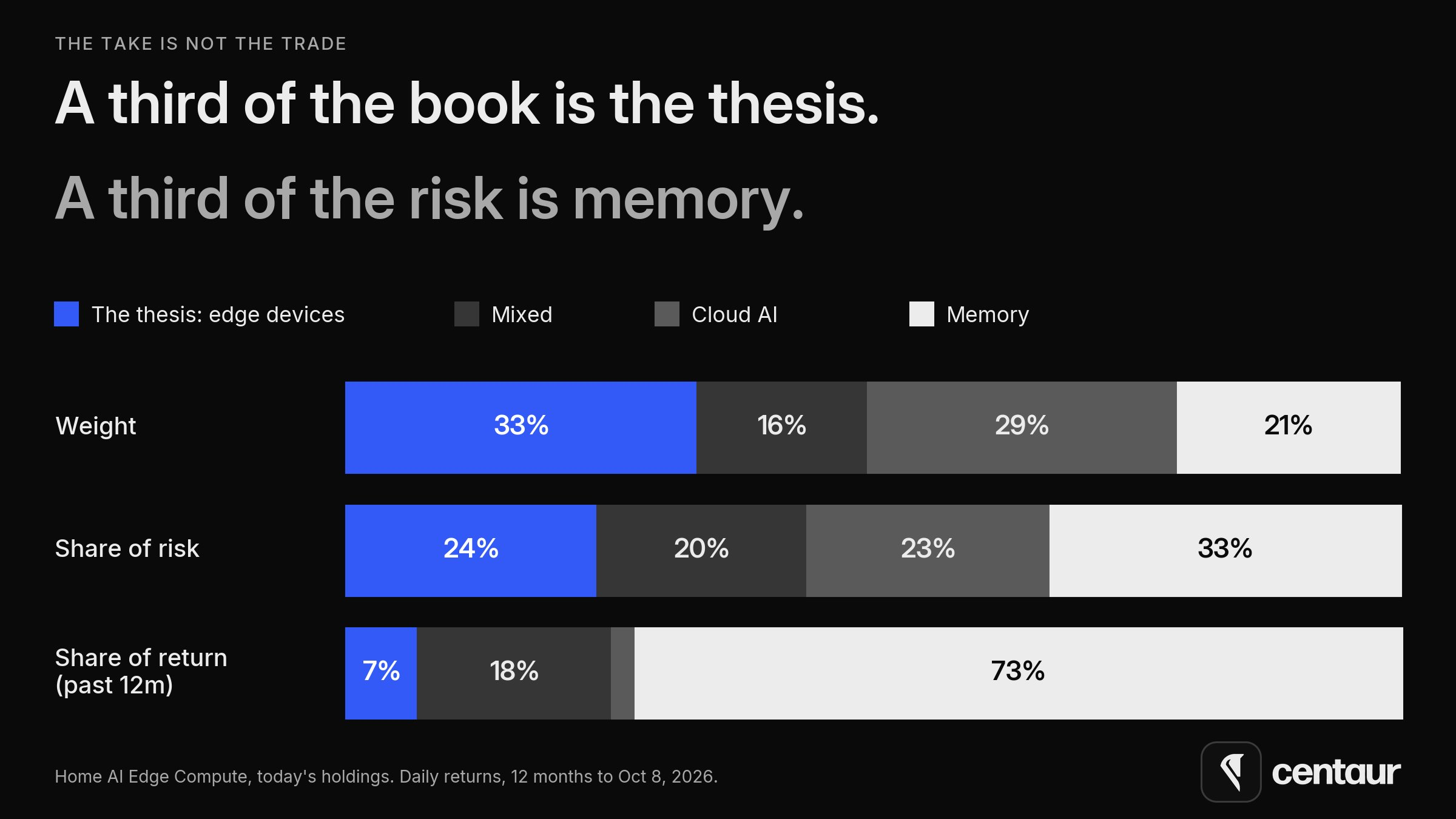
A third of the book is the thesis. A third of the risk is memory.
Go back to 27 January 2025, the day of the DeepSeek sell-off. The market got sharp evidence that frontier-class models can be cheap and open, which is aligned with Nikita's thesis. AAPL rose 3%, HPQ 2%. The book as built in October 2026 would have fallen 6%, because NVDA and AVGO fell 17%.

Good news for the thesis. A bad day for the book.
The same test on Supertake's top takes yields the same result.

Among Supertake's top eight takes, only two bets.
Two factors explain 92% of the variation across the books: AI hardware and software. The effective number of independent bets is closer to 2.1.

One ETF explains most of each book.
For every take, one off-the-shelf ETF explains roughly 70% to 90% of moves. Cyber Consolidation is a winners-versus-losers thesis, yet it tracks the cyber ETF (CIBR) at R² 0.92. If these takes translate into buying a broad and popular market ETF, which is fine, they should at least be honest about it.
The pattern across all of them: a take names something specific, then the book tries to buy the theme around it. But if that trade expression brings the sector factor with it, the factor drowns the take.
Part 2, The Four Stages of Alpha, covers what it takes to turn a take into a trade.
Method: Supertake holdings as of 3 to 4 October 2026, sleeve weights split equally across tickers, daily returns over the 12 months to 8 October 2026, Yahoo Finance data. Backtests apply the October 2026 holdings to the past; none of these books existed then.

