
In Centaur's out-of-sample test, the top five leaderboard traders went from +16% per position to -2%. A team picked on hit rate and independence was profitable in 77% of weeks.

Centaur · Research
October 29, 2026 · 4 min read

Social trading venues converge on a basic primitive: leaderboards, sorted by returns.
The underlying assumption is that performance persists, as with most things in life. In fact, in trading arenas such as memecoins or attention-driven assets with tiny market caps, there is a mechanic supporting that persistence.
The top wallets are always being tracked, exit liquidity is farmed into PnL, legends are born.
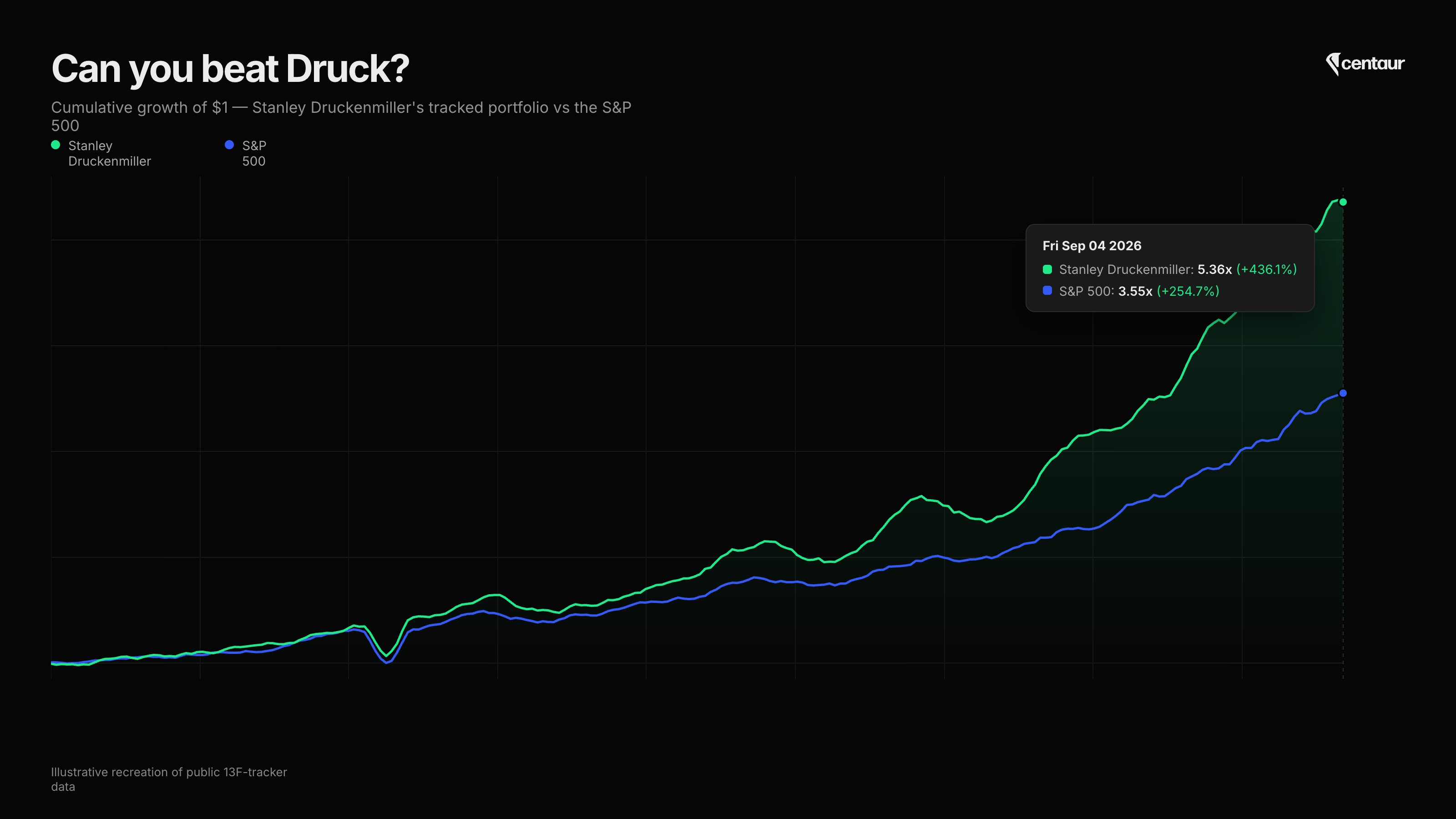
Built from Druckenmiller's quarterly 13F filings: each quarter's disclosed holdings are tracked until the next filing, then chained into a growth-of-$1 line against the S&P 500 over ten years.
In the broader investment world, it is not that simple. Past performance does not guarantee future returns is a truism, which traders are meant to partly ignore, but it also encapsulates a deep truth. Because market timing and shorter-timeframe trading are so unpredictable, persistence should not be trusted in the short term.
You might be beating Druckenmiller in 2026 if you put on some average AI bottleneck trades early. Damn, you might have beaten the whole Soros gang if you bought Bitcoin in 2014. But over a longer timeframe, and over a larger sample of bets, you will fall behind. Given sufficient time and reps, persistence should hold. The better investor is the one who wins this game.
Centaur ran this persistence check on its own data. The study took about 100 traders with enough positions and trading history, then sliced the eight months of trading history to early September 2026 into two windows: the first used to rank and sort, the second used to evaluate out of sample.
Across the top 30 first-half performers, the correlation between past and future returns was 0.02, in other words zero. The five names at the top of the leaderboard at the end of month four, the traders users are most inclined to follow, averaged +16% per position in the selection window. Evaluated in the second half, the same five traders averaged -2%. The single best trader, a very well-known AI bottleneck trader showing an 81% hit rate and +25% ROI per position, turned ordinary. Win rate dropped to 50%, and ROI to a meagre +1.7%.
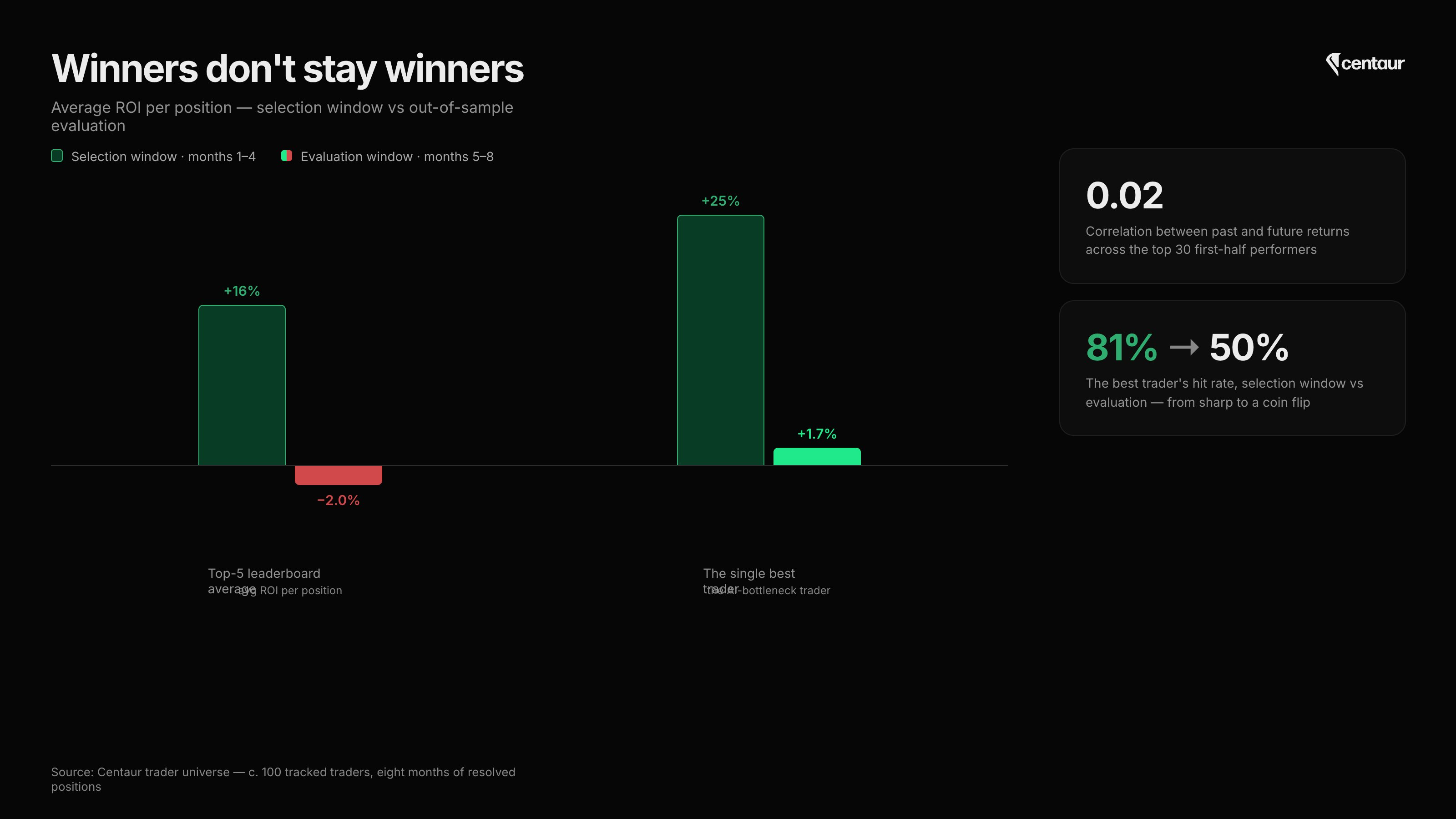
The same five traders, before and after selection: +16% per position becomes -2%. Past returns predicted nothing, with a correlation of 0.02 across the top 30.
This is why persistence over shorter timeframes is almost non-existent.
So Centaur tried another methodology. Philip Tetlock's superforecasting work showed that calibrated, independent forecasters, aggregated, beat any star forecaster. This is the playbook forecasting science settled a decade ago.
Translated to Centaur's analytics, the study selected on win rates, stripping out traders with heavily correlated bets and returns. For Centaur, trading on the insights and signals generated from social trading does not mean borrowing conviction or following the herd. It rests on the understanding that the positioning, and the often uniform thinking, seen in the social trading arena can be used to a trader's advantage: to be early, to be contrarian, to gain conviction or to stress-test a thesis.
The study then compared a superteam, five traders selected on performance and independence, against the five traders with the best performance, the all-star team. The results were clear.
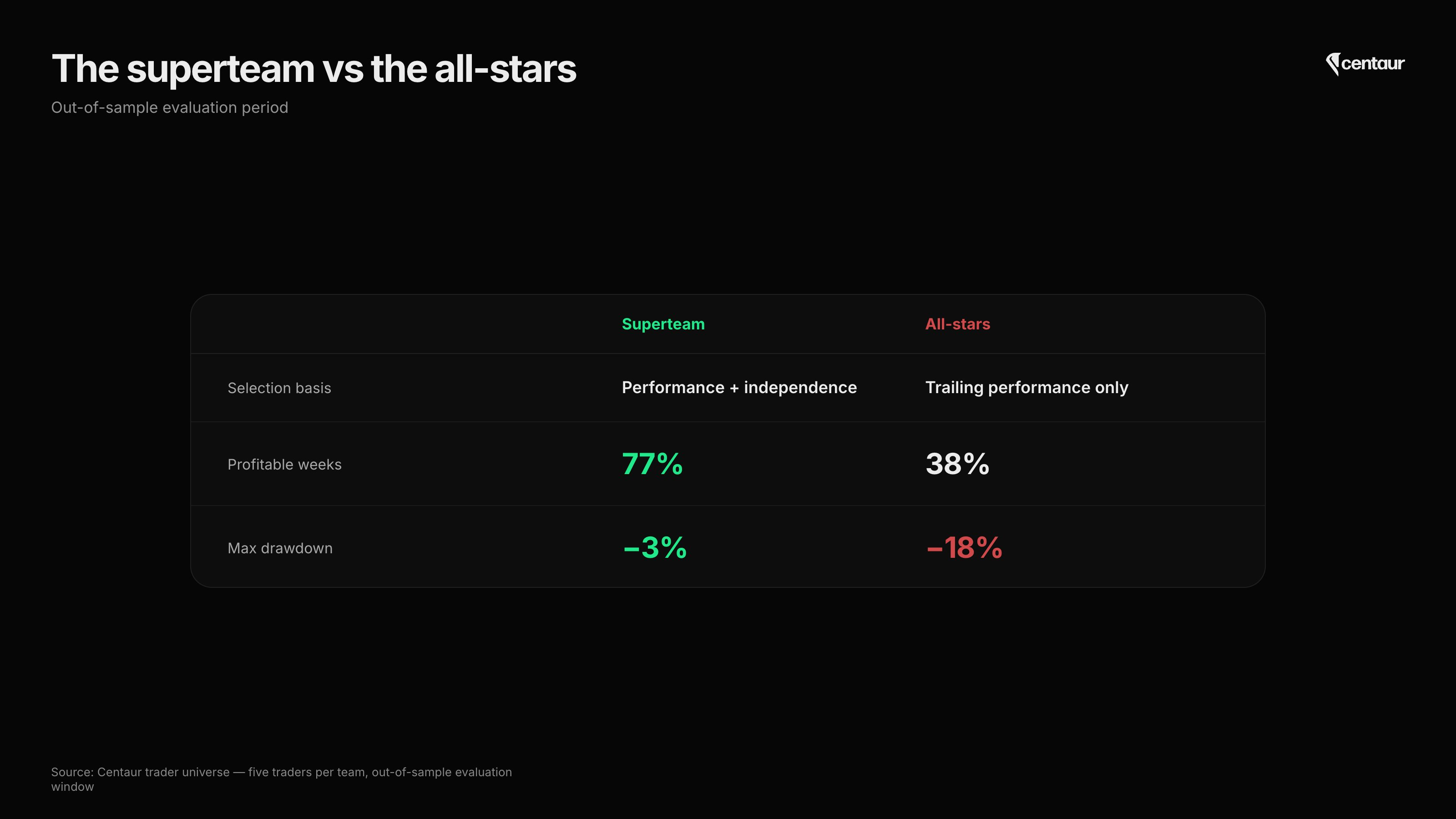
Selecting on hit rate and independence instead of trailing returns doubled the share of profitable weeks and cut the drawdown to a sixth.
The all-stars were negative in 62% of weeks in the out-of-sample evaluation period, with a drawdown many times deeper than the superteam's. The all-stars were taking the same bets, and once the market turned against them, they struggled.
The superteam, on the other hand, was profitable in 77% of weeks, and its worst peak-to-trough stretch cost only 3%. This is what monitoring high-quality, independent signals buys you.
This is not computable from screenshots and hearsay. Social trading signals need verified, highly accurate positions.
This is the data layer Centaur is building, and the direction it is pursuing: bringing into the analysis calibrations and insights that screen on originality rather than on short-term, concentrated trailing returns.

