
Alpha is take, expression, management and portfolio. Thiel, Camillo, Burry and Soros each won at a different stage, and three fixes would help take-driven agents turn a take into a trade.

Centaur · Research
October 29, 2026 · 4 min read

Part 2 of The Take Is Not the Trade.
Part 1 showed that the top takes on Supertake are often factor bets. This part is the other half: what it takes to turn a take into a trade that works for a portfolio.
Alpha can be thought of as the product of a few investment operations: take × trade expression × trade management × portfolio management.
For a take-driven investor, each later stage keeps or leaks the take's edge.
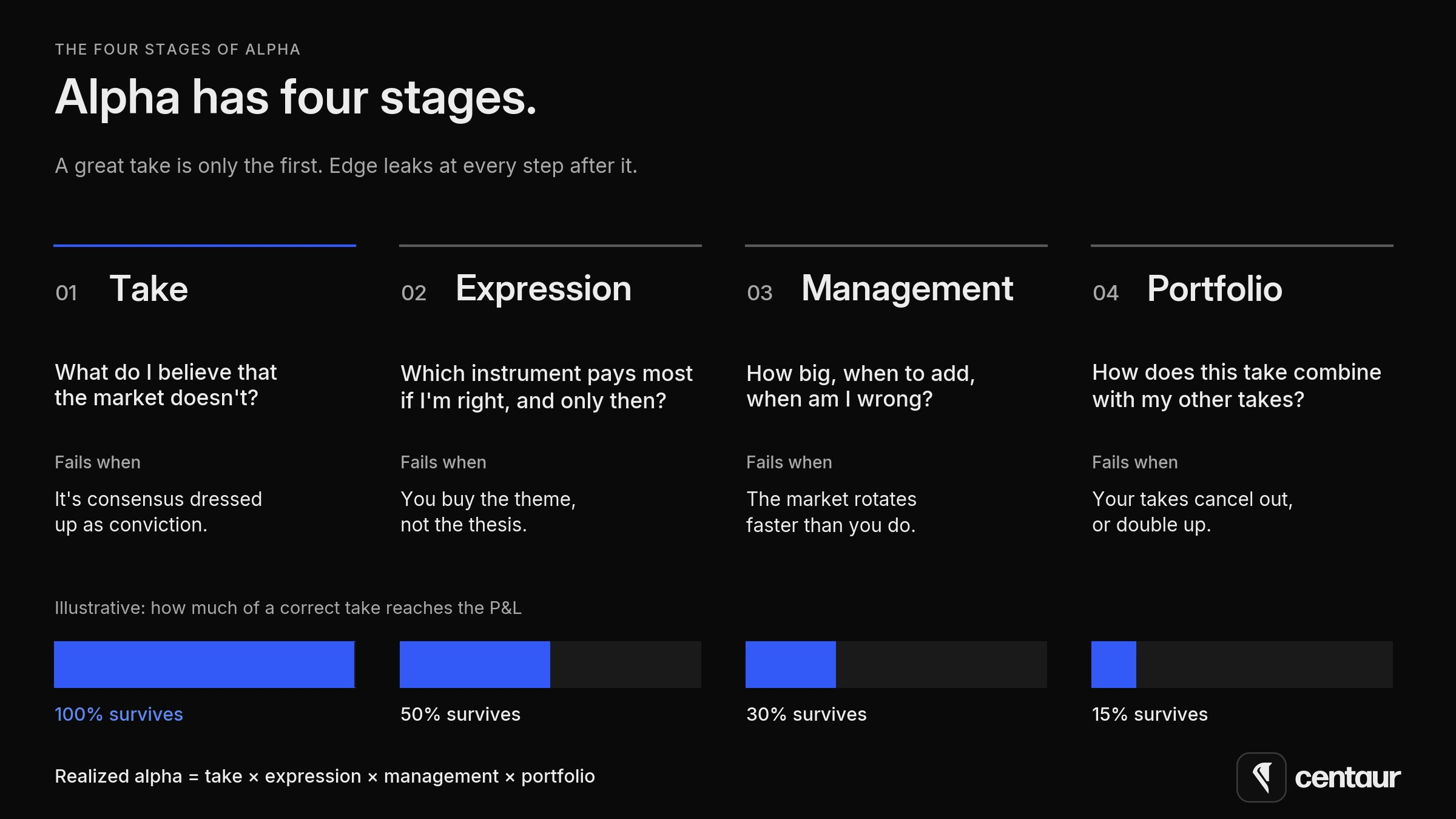
Alpha has four stages.
Take. What does the investor believe that the market does not?
Expression. Which instrument pays if the investor is right, and only if they are right?
Management. How big, when to add, and when is the investor wrong?
Portfolio. How does this take combine with the investor's other takes?
Every great investor is great, at a minimum, at one stage.

Thiel is the exemplary contrarian. His interview question, "what important truth do very few people agree with you on?", is the take stage in one line. Yet his macro fund Clarium, where takes had to be expressed and timed in liquid markets, peaked at $7 billion in mid-2008 and lost money three years running. Clients who stayed lost about 65% from the peak, and assets fell about 90%. Great takes, sometimes accompanied by weak expression.
Chris Camillo, who coined "social arbitrage", made his name connecting the dots. His takes start as everyday observations, like kids making slime at home. The edge was the next step: tracing the trend to an investable company and taking leveraged exposure before the trend showed up in earnings. His own rule is to act only on information big enough to move a company's numbers. Profiled in Jack Schwager's Unknown Market Wizards, he turned about $20k into tens of millions. The observation is available to all, but making the connection is the edge he sharpened.
The Big Short is an expression story. Plenty of people thought housing was a bubble in 2006. Michael Burry and John Paulson made fortunes because they found an instrument, subprime CDS, that paid many times over if they were right and capped the loss at the premiums if they were wrong. Being early still hurt: Burry paid those premiums for two years and fought his own investors before the trade paid off.
Soros on sterling, 1992, is a management story. The devaluation view was widely debated. The edge was size: when the setup was right, Soros pushed Druckenmiller to go much bigger.
Trend followers tend to have no take at all. Their entire edge is sizing and exits. Multi-manager pods pay only for the residual. They hedge factor exposure out and judge PMs on what is left.
Supertake's core idea is right: a take should become a bet, and bets can be shared, scored, and invested in. The gap is that today's scoreboard is driven by index or factor returns, not by the take.
Three things would close the gap:
The take is the beginning of alpha. Your portfolio exposure decides whether it stays yours.

