
Before Centaur, its founding team built Zap to track crypto Telegram calls. What the trenches taught them, and why Centaur now builds for every major market.

Centaur · Research
October 27, 2026 · 6 min read

Trading has turned retail, and it has turned social. Nowhere is that clearer than in crypto. Before Centaur, the founding team built a venture called Zap, a first attempt at capitalizing on that observation. On Telegram, thousands of channels were calling micro-cap tokens in real time, and those calls were moving prices forcefully before charts caught up. This is because the social layer is not simple commentary on memecoins, it is their momentum.
This is not a crypto-only phenomenon, and it is not new.
In February 2026, Citrini published a scenario piece that was explicitly framed as fiction, a hypothetical memo written from 2028. Within two days, it had been amplified by other legendary investors such as Michael Burry, racked up millions of views, and helped trigger a real selloff in the markets. The Dow fell close to 2%, IBM had its worst day in decades, and names like American Express ($AXP), DoorDash ($DASH), and Blackstone ($BX) each dropped sharply.
The US President's posts on Truth Social highlight the same point. In April 2025, a single post telling people it was “a great time to buy,” followed hours later by a tariff pause announcement, sent the S&P 500 up 10% and the Nasdaq up more than 12% in one session. The post is enough, and it now costs up to $100,000 a month to get early access to his posts.
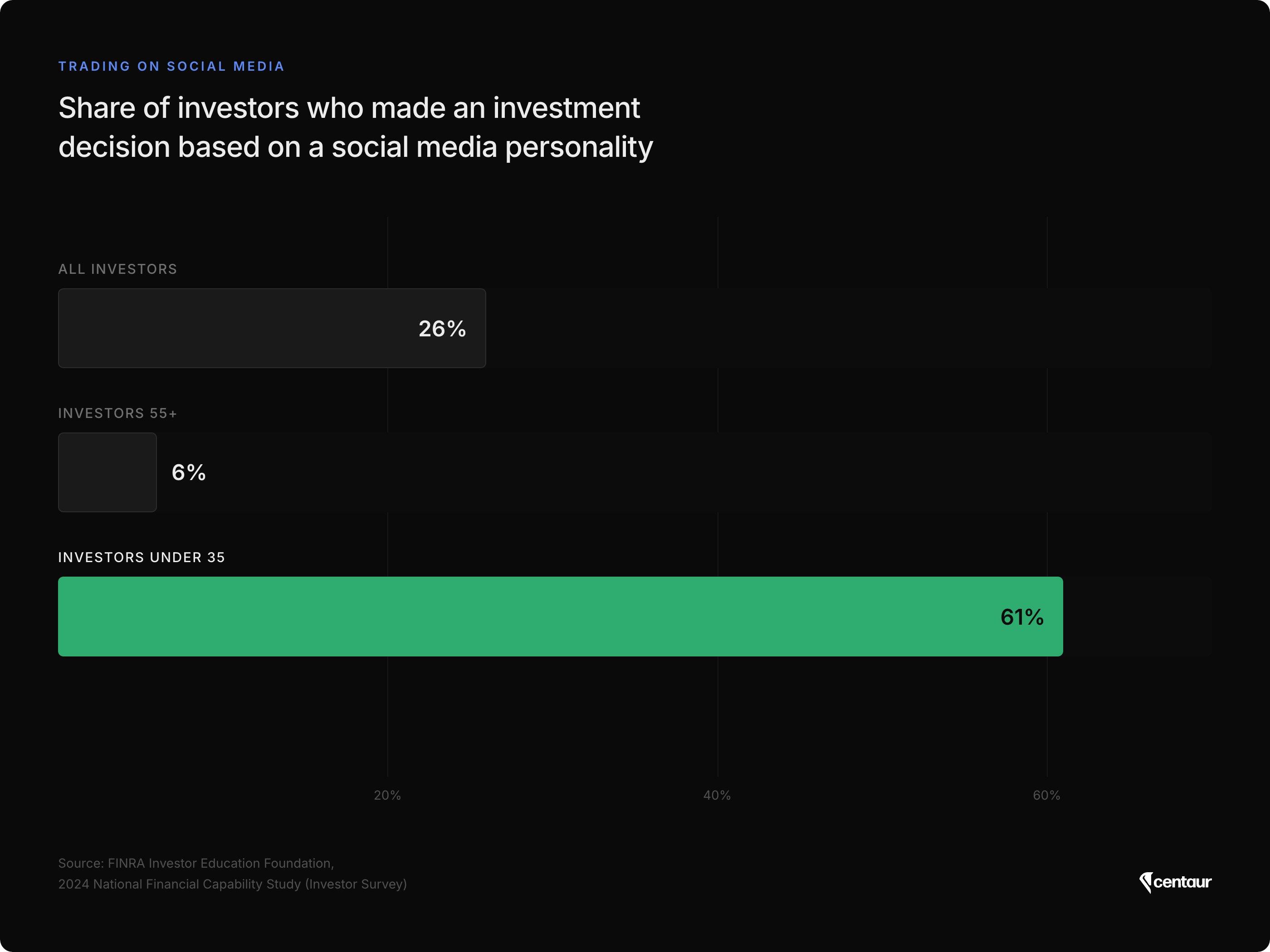
This is not confined to professionals reading professionals. The FINRA Investor Education Foundation’s most recent National Financial Capability Study found that 61% of investors under 35 have made an investment decision based on a recommendation from a social media personality, compared with just 6% of investors 55 and older. For a generation of investors, social platforms are not a side channel. They are where the process starts.
These are truths the founding team witnessed as traders long before they tried to build a company around them. For the past five-plus years, Tony Cotzias, Centaur's founder, has followed the giants on X, studied their theses, and treated their calls as raw material for his own ideas. Not because it was rigorous, but because it was where the information moved first.
When Tony started trading crypto, the pattern became impossible to ignore. His best trade ever remains buying $WIF the moment Ansem posted about it. He says he will top it one day. Centaur is building the engine for that.
Zap monitored trades from virtually all public crypto Telegram channels, exceeding 3,000 of them. Who called what, when, how credible the caller had been historically, how far the call spread through the network. In effect, the team was building the closest thing to a fundamental signal in the trenches: the caller’s track record and their reach. It was a genuinely powerful dataset for that market, and building such tools taught the team a great deal about how attention actually flows through a market in real time.
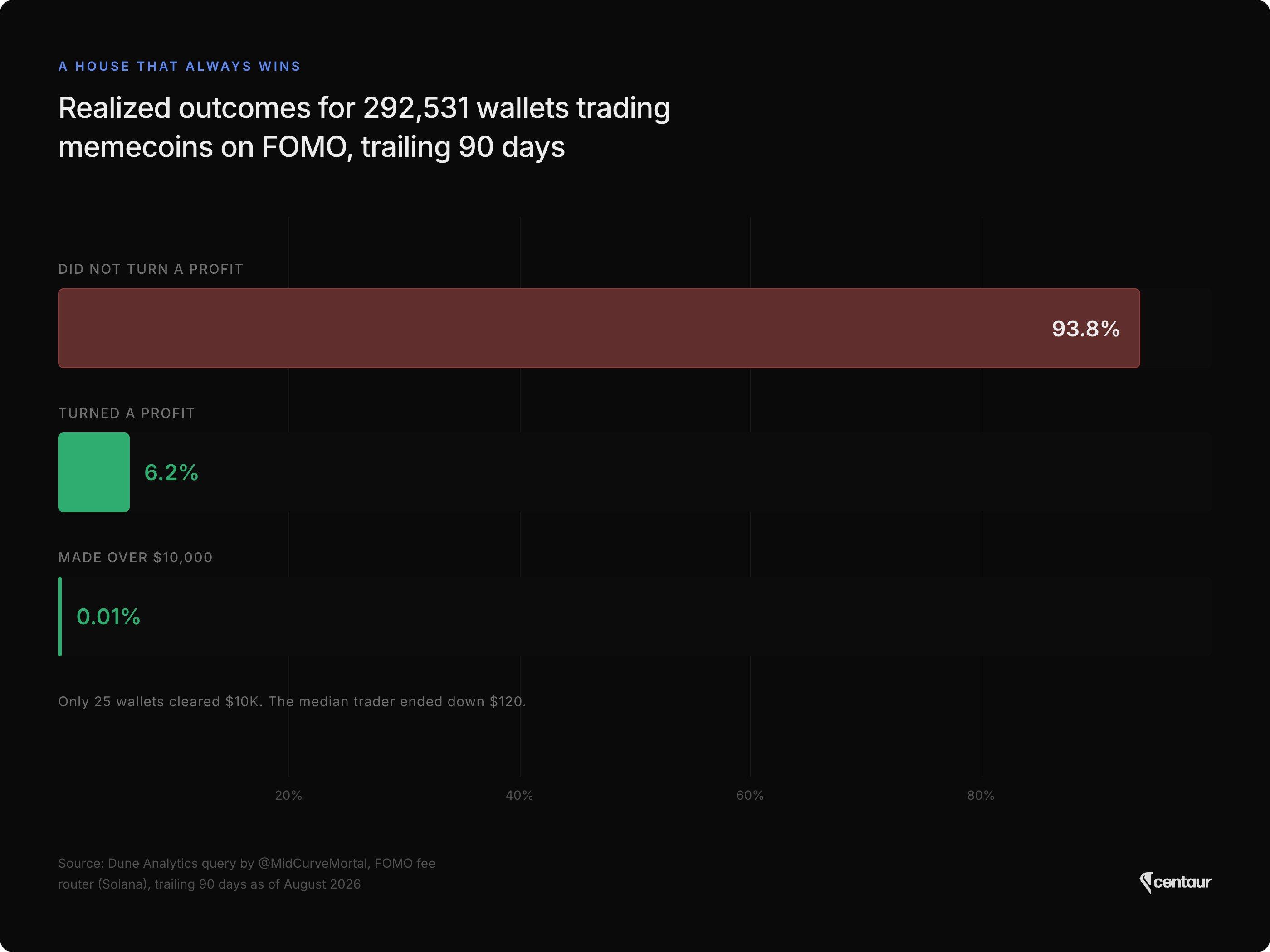
Yet, it also taught the team what it did not want to keep building for. The stats on these markets are brutal, and not in an abstract way. A public Dune Analytics query covering the 292,531 wallets that traded through FOMO on Solana over the trailing 90 days found that just 6% of them turned a profit. Of the winners, 88% made under $100, and only 25 wallets in total cleared $10,000. As a group, traders were down $1.3 billion.
Retail day trading does not fare much better. The most rigorous long-run study of retail day traders, tracking everyone who started day trading Brazil’s equity futures market between 2013 and 2015, found that 97% of those who persisted for more than 300 days lost money, with only 1.1% earning more than minimum wage for their effort. A parallel study of the entire Taiwan Stock Exchange over 15 years found that fewer than 1% of day traders earned reliably positive returns after fees.
Centaur is not building for these cohorts. Day traders and trenches degens represent massive markets, where social analytics has great product fit, but it is not an infinite game, not the dominant game to play. Centaur's interest is in the investor who wants a real edge in positive EV markets. However good the extraction gets, you cannot build durable value on top of an asset whose only reason to exist is to be traded on attention.
Centaur kept the thesis and changed the focus. It moved the same approach, extracting structured signal from unstructured social communication, onto assets that have actual fundamentals underneath the noise. Equities, commodities, indices, large-cap crypto assets, i.e. all major markets. This is a harder problem, not an easier one. For a memecoin, attention is close to the entire pricing model. For a real asset, attention is one input competing with earnings, macro conditions, positioning, and every other force that also moves the price.
The question changed twice over: first from extracting calls out of the noise to working out what the social signal is worth next to everything else that matters, and then to how social trades combine into aggregate signals that carry alpha. That is a much bigger and more open-ended product problem, but it is the right market to be solving it in.
There is a lesson from the trenches worth stating plainly. A public thesis and a matching sell order from the same account, in the same market, in the same hour, is not really a contradiction there. It is actually the mechanism that moves these markets, because attention is the only fundamental a memecoin has. No one expects these assets to have durable value.
That is a fine game for people who know they are playing it. It is not a market the team wanted to spend the next decade building the best analytics and infrastructure for. The team built Centaur to bring unparalleled rigor to markets where the asset is not entirely dependent on attention, and where a thesis is tested against the outside world rather than against itself. That is where reading attention correctly is an edge, rather than the whole game, and that is the dataset worth building on.

