
How Fomo won social trading, why almost nobody can repeat it, and where every other trading app should look for its edge instead: execution, speed, fees, interface and ideas from every town square.

Centaur · Research
October 30, 2026 · 8 min read
Fomo is the most successful social trading app crypto has produced.
It launched in May 2025. Seventeen months later it has raised about $94m, sits at a $550m valuation, has climbed into the top five US finance apps on the App Store, and has 2.7m users. In September 2026 it earned $36m in fees.
This did not happen by accident. It unfolded quite masterfully.
Before any fund wrote a check, Fomo's founders made a list of 200 dream angels and cold-called them. 140 of them got on the cap table. Crypto founders, traders, creators, operators: the people whose timelines the rest of the market reads.
The money from each individual was small. The ownership was the point. Every one of those angels had a reason to download the app, use it in public, and tell their followers about it. When your earliest promoters are also your shareholders, nobody has to be paid per post. Incentives are aligned from day one.
It also bought credibility upstream. Three different people offered to introduce the founders to Benchmark. Benchmark, which rarely backs crypto, led the $17m Series A in November 2025. Index Ventures led the $75m Series B in June 2026, along with USV and Benchmark.
Fomo started with memecoins.
In memecoins there is no cash flow to model and no earnings call to wait for. There is only who saw it first and who followed. That makes social trading not a feature but the product: seeing what the people you follow are buying, the moment they buy it, is the entire edge. That is why product-market fit was strongest there.
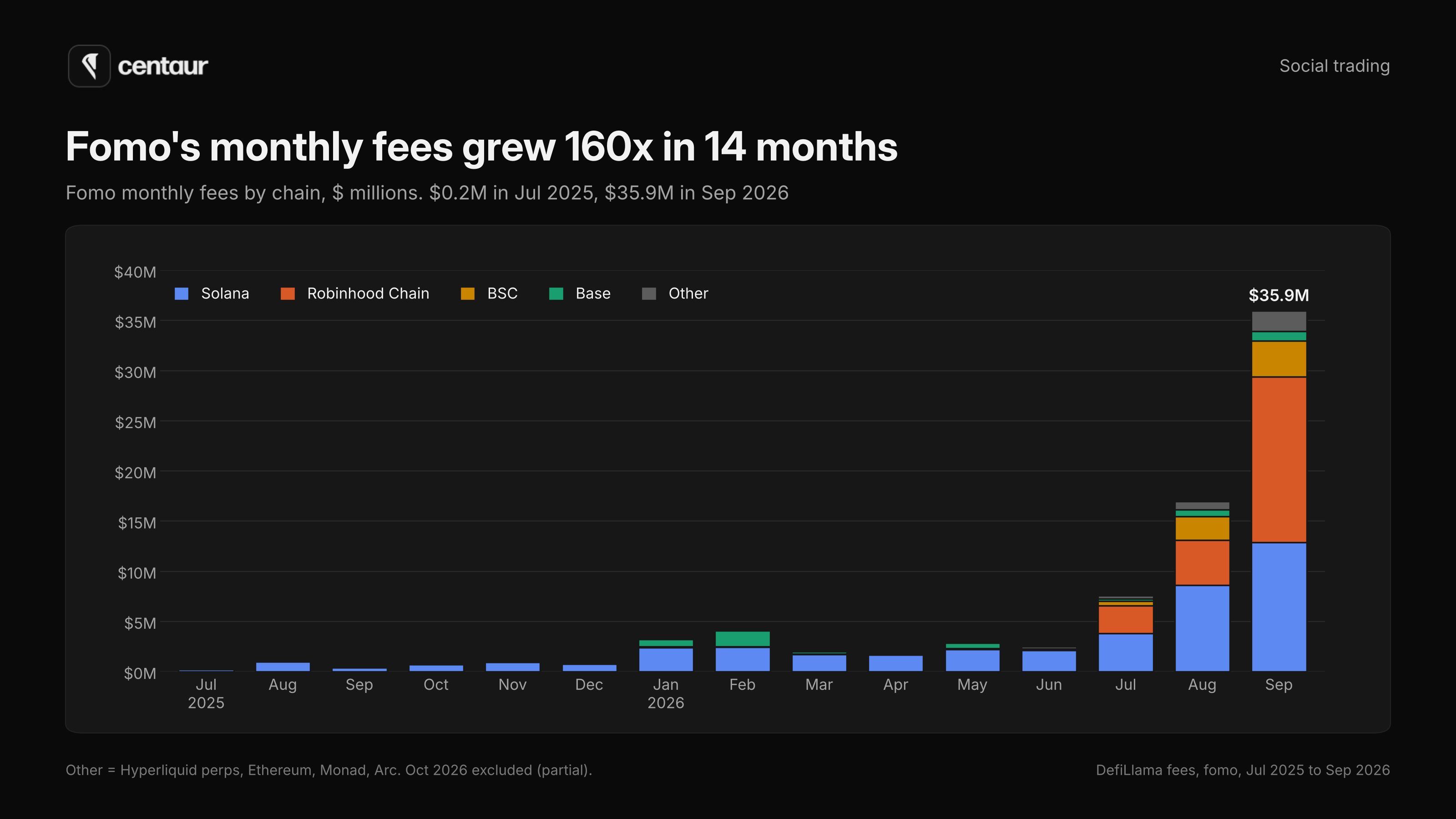
Fomo's monthly fees grew 160x in 14 months. Source: DefiLlama fees, fomo, July 2025 to September 2026.
When Fomo launched in May 2025, its competitors were earning over $100m a month in fees. By June 2026 that pool had fallen to $26m, down more than 80%. The memecoin trade had cooled, and the incumbents had stopped innovating. Photon earned $85m in January 2025 and $0.4m in September 2026. BullX went from $55m a month to roughly zero.
Fomo grew straight through it. Its share of that pool went from 2% in November 2025 to 10% at the June 2026 low. When activity came back, it captured the rebound: 28% of the pool in September 2026, alongside Axiom and GMGN.
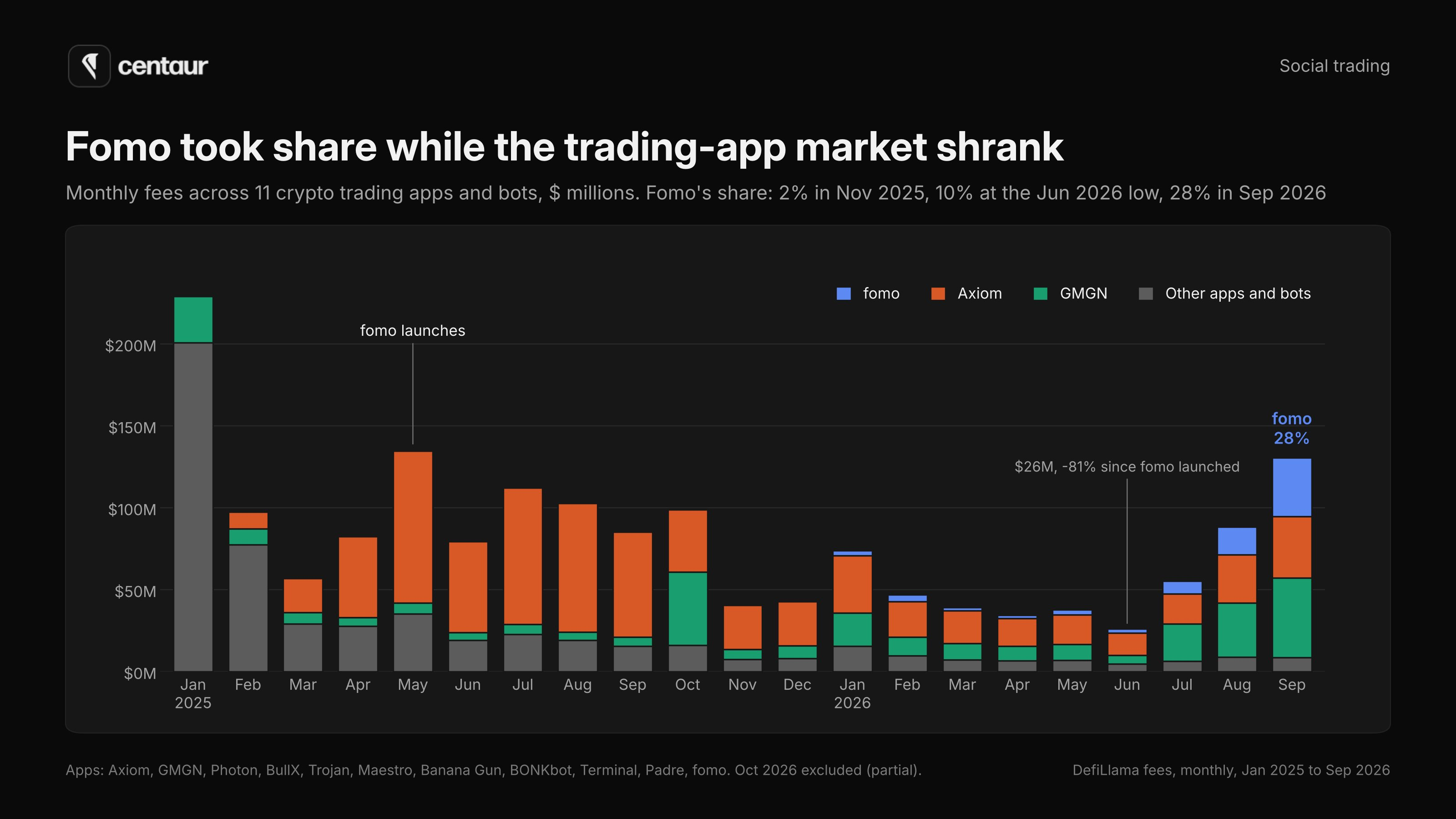
Fomo took share while the trading-app market shrank. Source: DefiLlama fees, monthly, January 2025 to September 2026.
The three survivors won on three different edges. Axiom and GMGN are terminals: speed, data, execution. Fomo is a phone app: social, simple, fast to start. The Telegram bots that won the last cycle had none of these, and they are now more or less gone.
Fomo's interface is the best in its category, and it was built for the person who has never touched a bridge. Onboarding takes about 30 seconds. You fund with Apple Pay. One balance trades across chains, with no gas to manage. By June 2026, 68,000 people had bought crypto for the first time inside the app.
The ratings back it up: 4.6 to 4.8 stars on the App Store from more than 14,000 reviews, and over a million installs on Google Play.
Put these ingredients together and the flywheel starts turning:
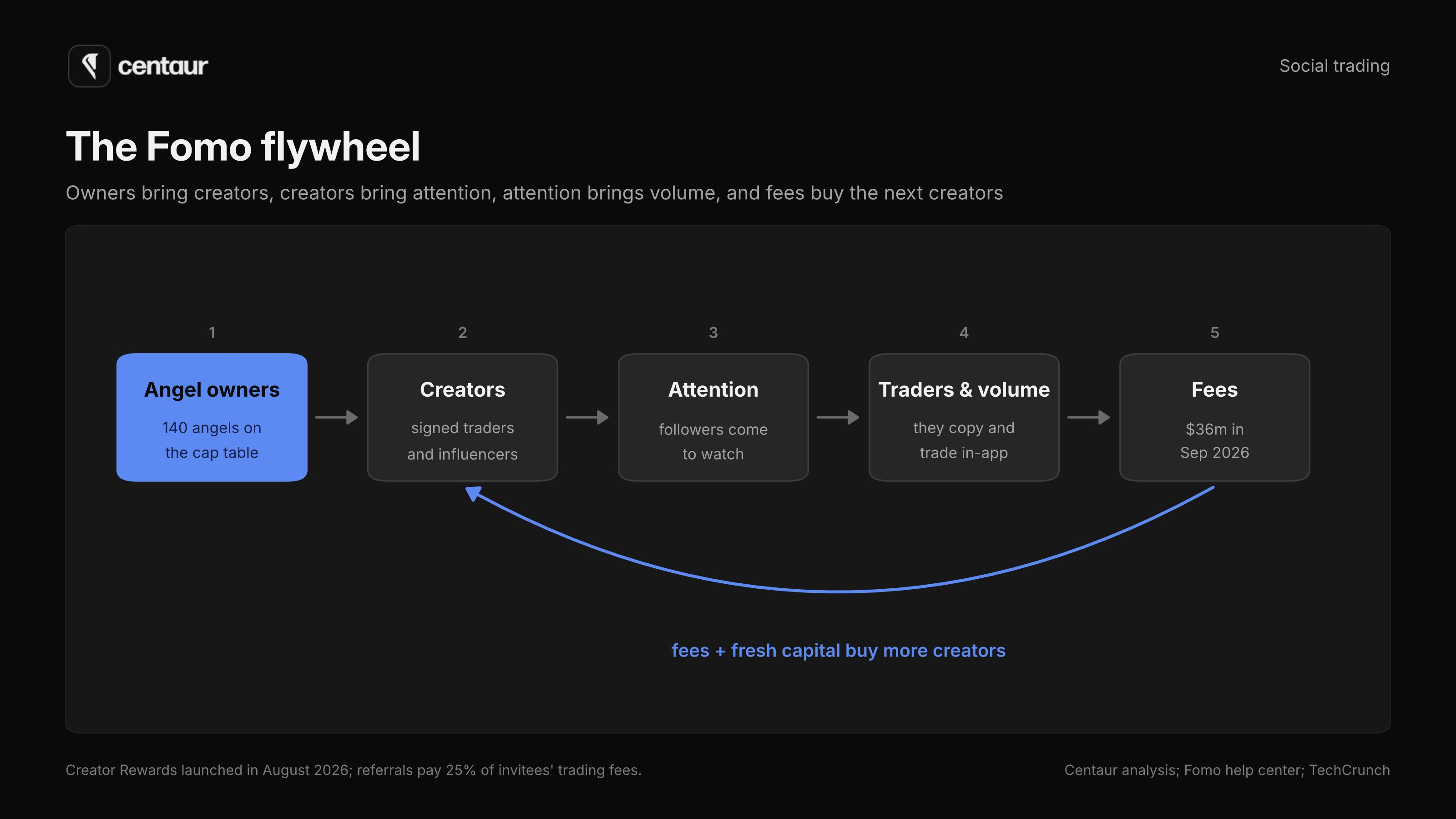
The Fomo flywheel.
On 1 November 2025, Fomo's revenue was running at $9m a year. By 26 September 2026 it was running at $398m. That is 44x in under eleven months.
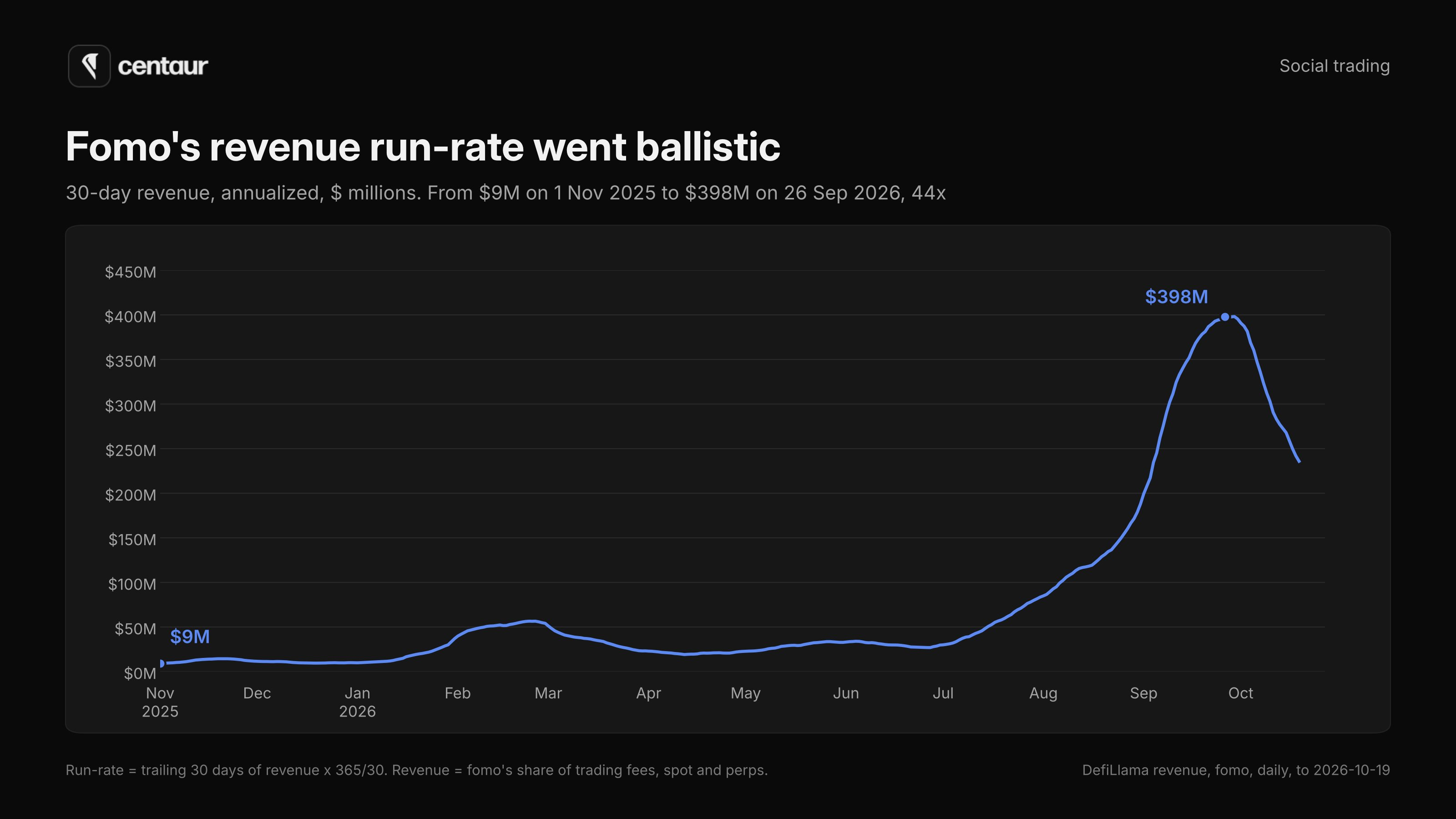
Fomo's revenue run-rate went ballistic. Source: DefiLlama revenue, fomo, daily, to 19 October 2026.
As of October 2026, Fomo has the leading product for sharing theses and trades, a war chest funded by investors and its own fees, and the deepest bench of signed creators of any venue. At the end of August it bought Mobula's technology, the on-chain data layer behind its token feeds and safety signals, in a $17m deal. It is now pushing into perps, equities and prediction markets.
Good luck beating them at their game of trader monetization and influencer bundling.
Robinhood is the tradfi counterpart. It has the users, the balance sheet and the regulatory reach to build a powerhouse of a social trading experience for traditional markets, and it probably will. But that is a different game, played on different assets. For almost everyone else trying to copy Fomo's playbook in crypto, the conditions that made it work are gone: the owner-angels are taken, the creators are signed, and the flywheel is already spinning.
Here is Centaur's thesis.
There can never be one arena. Not all great traders will be on your app. Not even on Fomo.
The world's best trading ideas are posted wherever their authors already have an audience. Centaur's trader registry holds c. 3,000 traders, of whom about 300 are live in the product today, each switched on only once extraction for that trader passes 90% accuracy. Of the registry, 89% are on X, 29% are on Telegram, and a quarter run their own website. And that is before counting TikTok, Substack and Spotify, where much of the next generation of analysts is building its audience.
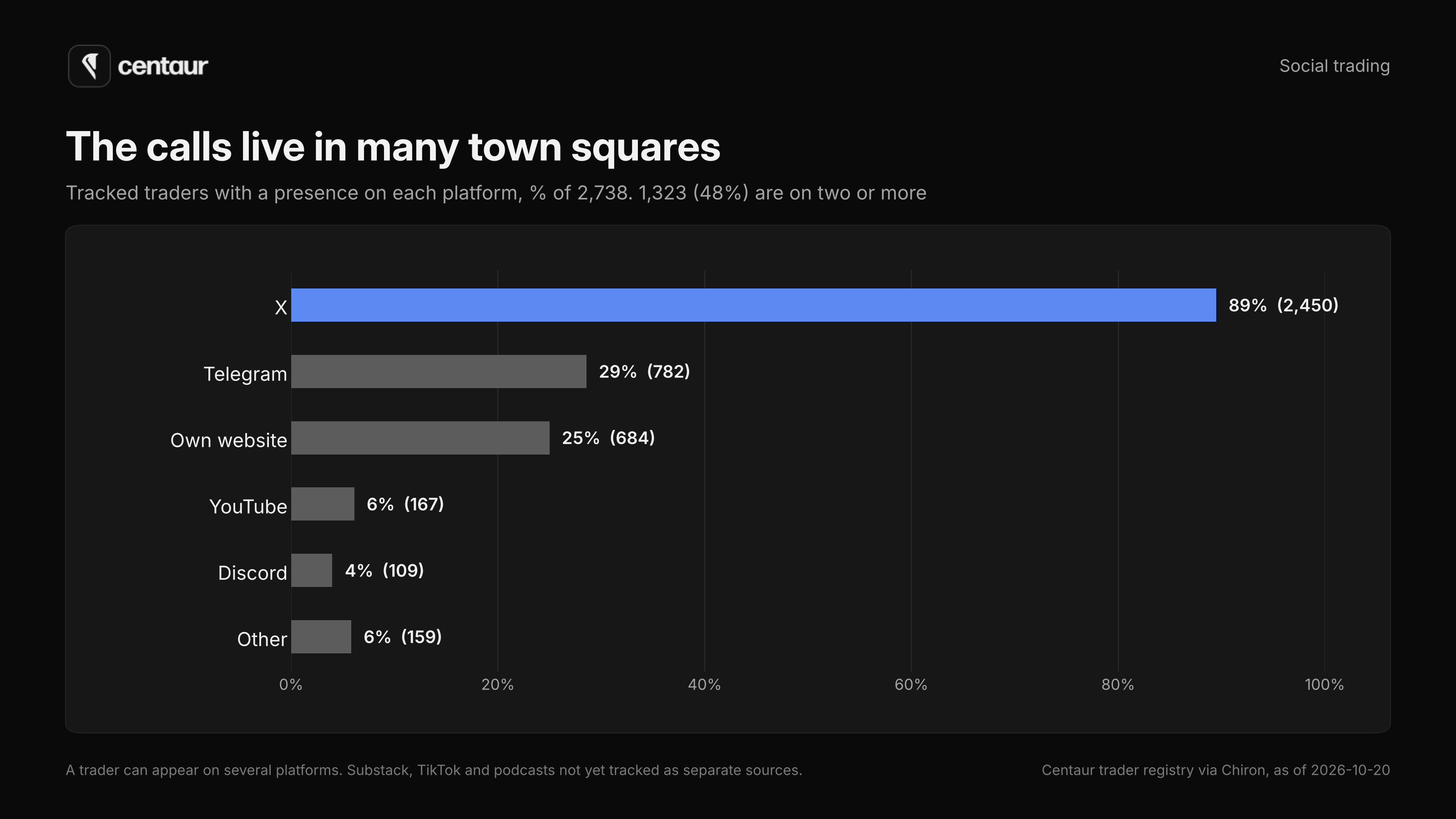
The calls live in many town squares. Source: Centaur trader registry, as of 20 October 2026.
The followers are just as spread out. In the FINRA Foundation and CFA Institute's study of Gen Z investors, social media was their single most-used source for learning about investing, ahead of search, family and friends. Among those who learn online, 60% use YouTube, 44% Instagram, 37% TikTok, and 34% each X and Reddit. No one platform owns the young investor's attention. And while 48% use social media to learn, only 12% name it among their most trusted sources. Centaur is building this trust layer, but that is another story.
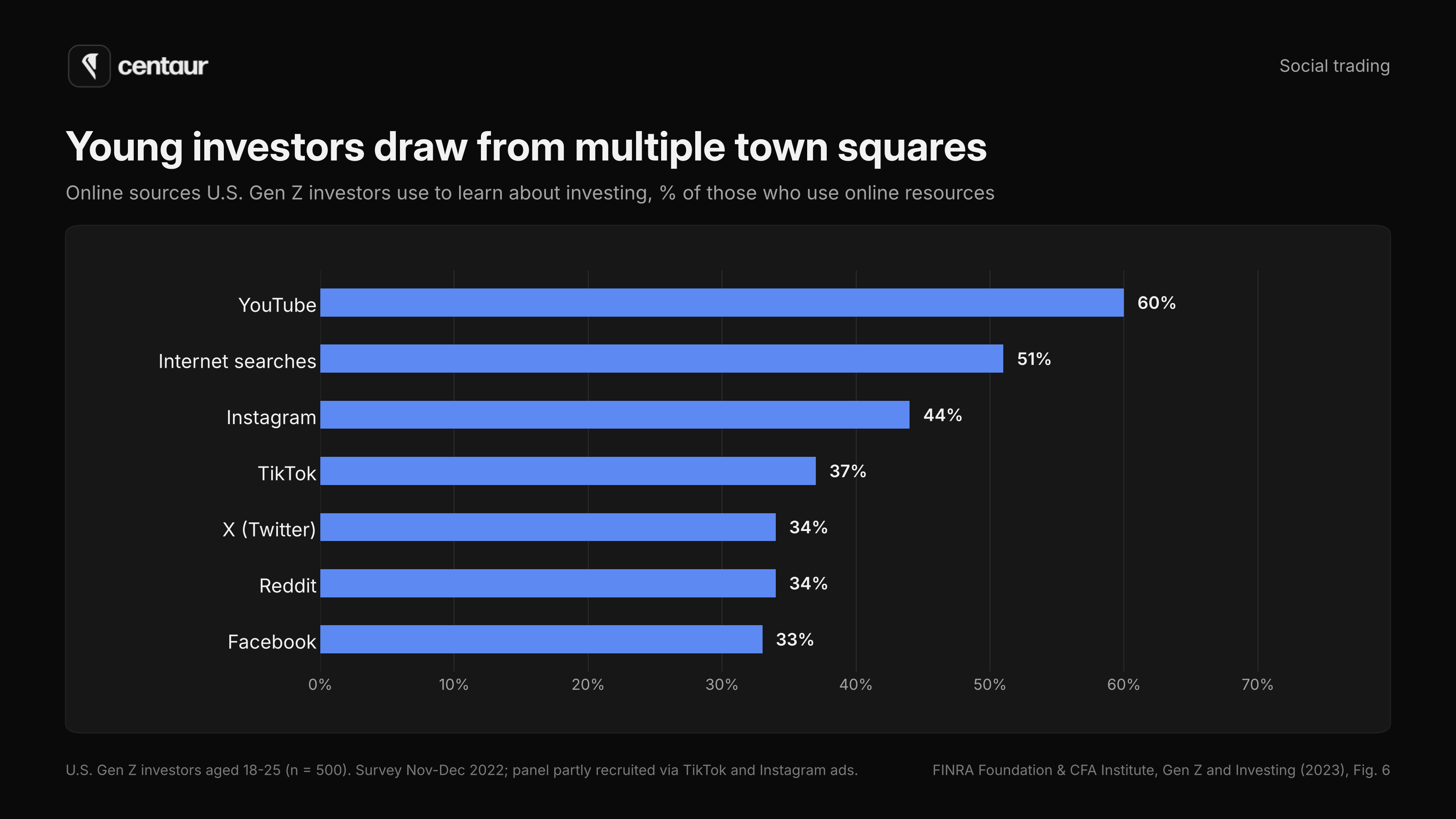
Young investors draw from multiple town squares. Source: FINRA Foundation & CFA Institute, Gen Z and Investing (2023), Fig. 6.
The networks where people gather will always be the world's town squares: X, YouTube, TikTok, Telegram, Discord, Substack, Spotify. They are many, they are different mediums, and none of them is a trading venue. As Centaur showed in Why Are All of Your KOLs on Fomo?, even Fomo has signed only 18 of the 293 traders in Centaur's trader monetization study.
Which means aggregate, cross-platform discovery will always matter.
So, to the trading exchanges and apps out there: do not try to recreate Fomo. Tony Cotzias, Centaur's founder, has recently met many teams coming out of hackathons and stealth trying to build the Fomo of APAC or the Fomo on Sui. It is an extremely difficult task.
Instead, draw the world's best trading ideas from every town square, judged on their record, and build your app's edge elsewhere:
Fomo bundled the town square into the venue, and it worked. Others should treat the town squares as a feed, and compete on everything that happens after the idea arrives.
That is the layer Centaur is building: every trader, every platform, every call scored on whether it was right, to bring better trade discovery, higher-quality decision-making and improved trader PnL to your users.

